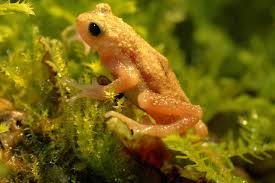
Most frogs lay eggs in water, and their young develop outside the mother’s body. But one tiny, rare frog from Tanzania breaks this rule completely. The Kihansi Spray Toad (Vyura wa Kihansi) is one of the few frog species on Earth that keeps its eggs inside the body and gives birth to fully formed live young — not tadpoles.
This unique ability makes it one of the most extraordinary amphibians ever discovered.
Let’s explore where these frogs live, why they evolved this strange reproduction style, and how they differ from other frogs.
1. Where You Can Find the Kihansi Spray Toad
The Kihansi Spray Toad is endemic — meaning it is found only in one place on Earth:
The Kihansi Gorge, Udzungwa Mountains, Tanzania
This gorge is a small, mist-filled environment where:
Waterfalls create constant fine spray
Humidity stays extremely high
Temperatures remain stable
Small mossy rocks stay moist all year
This “permanent mist zone” created the perfect home for the toad.
Because of this unique environment, Kihansi spray toads cannot survive in normal forests, ponds, or streams.
They need:
Constant water spray
Shallow, rocky surfaces
Very high humidity
This is why they became so specialized — and why they were nearly lost forever.

2. The Unique Reproduction: Birth Inside the Mother
Most frogs:
Lay eggs in water
Eggs hatch into tadpoles
Tadpoles grow into frogs
But the Kihansi spray toad is different.
How it gives birth:
The female does not lay eggs in water.
She keeps eggs inside her body.
The eggs develop into tiny froglets (not tadpoles).
She gives birth to fully formed miniature frogs.
This is called ovoviviparity, extremely rare among frogs.
It evolved because:
The Kihansi Gorge has little standing water
Eggs placed on surfaces would dry out
The constant mist was not enough to support free-floating eggs
So the toads developed an internal incubation system for survival.
3. What Makes Them Different From Other Frogs
The Kihansi Spray Toad is different in several major ways:
✓ No tadpole stage
The young skip the swimming stage. They don’t need a pond.
✓ Lives in a very tiny habitat
Less than 4 hectares of land originally.
✓ Very small size
Adult toads are only 1 inch (2–3 cm) long.
✓ Live birth
Like mammals, but in a frog form.
✓ Extremely sensitive species
Small environmental changes can easily wipe them out.

4. Near Extinction and Conservation Efforts
When the Kihansi hydroelectric dam was built, the natural spray environment changed.
The toads lost the mist that kept them alive.
By 2009, they were declared Extinct in the Wild.
But conservationists stepped in:
Some were taken to the U.S. for breeding
Zoos successfully raised new populations
A new artificial spray system was built in the gorge
The toads were reintroduced back to Tanzania
Today, they are slowly recovering — a huge victory for conservation.
5. Why This Frog Matters
The Kihansi Spray Toad is important because:
It exists nowhere else on Earth
It shows how animals can evolve to survive extreme environments
It represents Tanzania’s unique biodiversity
Its survival teaches us the value of conservation