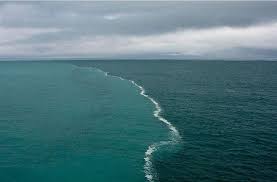
At first glance, the Atlantic and Pacific Oceans look like one giant body of water. But in certain places — especially near Alaska — you can clearly see two oceans meeting without mixing, creating a dramatic line where water of two colors appears to “touch but never blend.”
This natural phenomenon is real, but the reason behind it is more scientific than mysterious. Let’s explore why these oceans don’t mix easily and how this affects marine life living in the border zone
1. The Oceans Don’t Mix Because Their Waters Are Completely Different
✓ Salinity (salt level)
One ocean may have higher salt concentration, making its water heavier or lighter.
✓ Temperature
Colder water and warmer water resist immediate mixing.
✓ Density
Differences in salt and temperature change water density, causing the oceans to stay separated.
✓ Current Direction
The oceans have opposite-flowing currents, pushing against each other.
✓ Mineral and sediment content
One ocean carries more sediments, giving the water a darker or lighter color.
These differences create a boundary called a halocline — a barrier of salt and density that prevents the waters from blending quickly.
2. What Happens to the Creatures Living Between the Two Oceans?
The meeting point of the Atlantic and Pacific creates unique ecosystems.
1. Species Are Adapted to Specific Conditions
Some animals can survive only in:
Cold water
Warm water
High-salt water
Low-salt water
Because the oceans differ in temperature and salt levels, many species stay on their own side.
Examples:
Some plankton types live only in the Pacific.
Some fish and crustaceans survive better in the Atlantic.
Crossing the boundary could stress or harm them.
2. Some Creatures Thrive in the Transition Zone
Other species are adapted to survive in the mixed boundary where conditions change rapidly.
These include:
Salmon
Halibut
Cod
Certain jellyfish
Marine mammals like seals
These animals can tolerate different salinity levels, allowing them to cross the boundary.
3. Food Chains Are Different
Each ocean has:
Different plankton
Different nutrients
Different predators
When these systems meet, some species avoid the border while others use the boundary as a feeding area because prey can become more concentrated there.